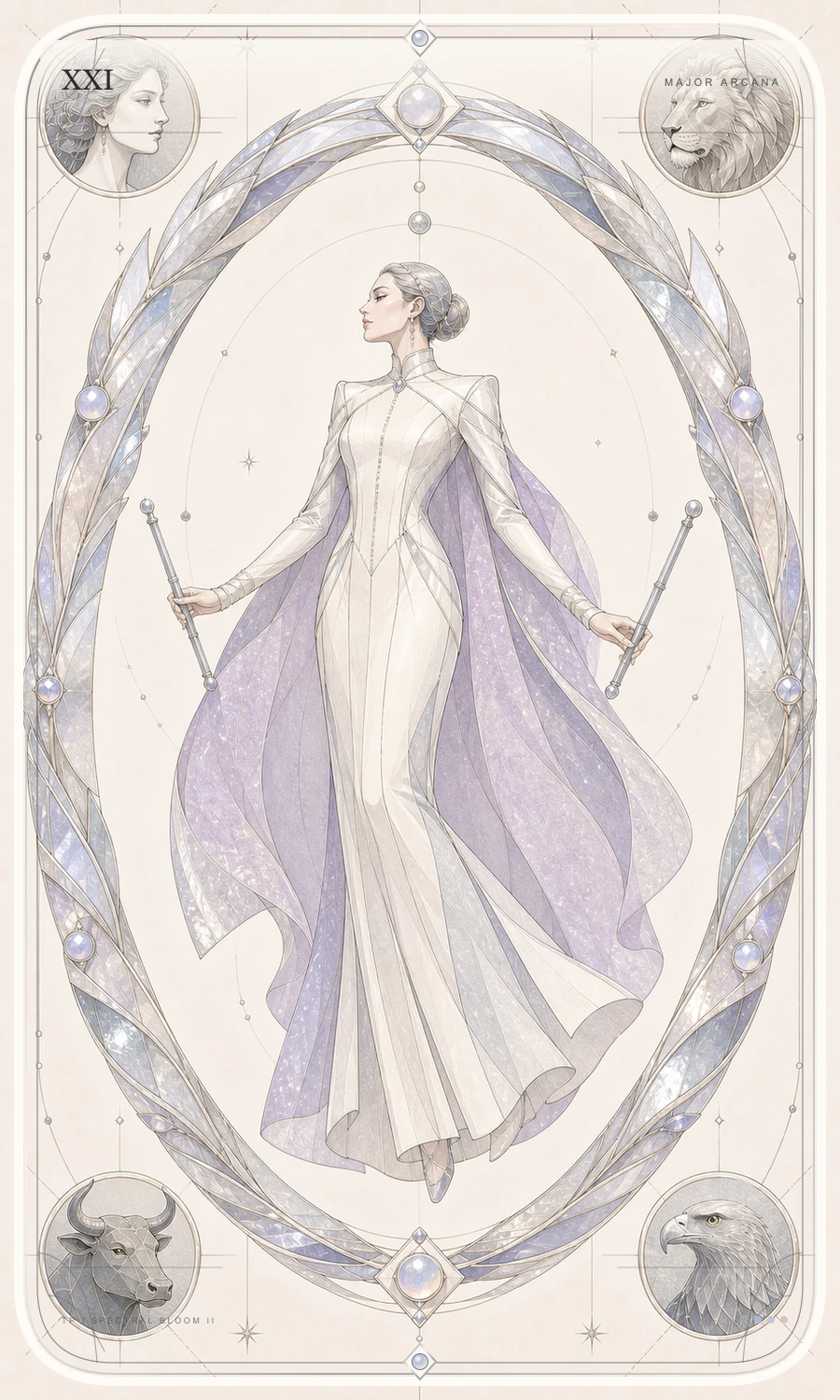
The deck has two scales of experience
A standard tarot deck contains 22 Major Arcana and 56 Minor Arcana. The distinction is not between important and unimportant cards. It is a difference of scale. Majors tend to frame a larger developmental theme; Minors show how experience moves through daily choices, feelings, conflicts, and material conditions.
When several Majors appear, the reading may involve identity, transition, or a pattern with lasting significance. When Minors dominate, the situation may be shaped by practical adjustments. Both scales matter: a profound change still happens through ordinary actions.
The Major Arcana as a sequence
The Majors begin with the Fool and move through figures, forces, disruptions, and forms of integration until the World. Readers often call this the Fool’s Journey. It is best treated as a learning map rather than a rigid ladder that every life must climb in order.
Numbers give orientation. Early cards often establish agency and relationship; the middle of the sequence tests attachment, perspective, and control; later cards engage disruption, hope, uncertainty, awakening, and completion. A card can appear at any stage because real development is rarely linear.
The four suits describe four domains
Wands often concern initiative, desire, and creative force. Cups concern feeling, connection, and imagination. Swords concern thought, language, conflict, and decisions. Pentacles concern the body, work, resources, and material reality.
These associations are lenses, not prisons. A work question can produce Cups when morale or relationship is central; a love question can produce Pentacles when reliability and shared resources matter more than romance.
Numbers show the stage of a process
Aces introduce potential. Twos create relationship or choice. Threes develop and express. Fours stabilize. Fives disrupt. Sixes reorganize. Sevens test position. Eights intensify or refine. Nines approach completion. Tens reveal the consequence and transition into another cycle.
Use this sequence as a question: What stage is this situation in? A Five does not automatically mean disaster; it may show that an old arrangement can no longer continue unchanged. A Ten may feel successful or burdensome depending on what has accumulated.
Court cards are roles in motion
Pages explore and receive messages. Knights pursue and mobilize. Queens embody inner mastery and relational understanding. Kings direct, decide, and hold external responsibility. A court card can represent a person, a role you are taking, or a style the situation requires.
Avoid assigning court cards to gender or appearance by default. Ask what behavior is visible. The Queen of Swords may be anyone practicing discerning communication; the Knight of Cups may be a romantic offer, a creative pursuit, or the part of you chasing an ideal.
Combine rank and suit before memorizing
If you forget a card, combine its number or court role with its suit. The Seven of Pentacles becomes a test of position within work and resources; the Page of Cups becomes curiosity or a message within emotion and imagination. Then let the picture refine the sentence.
This structural method will not reproduce every traditional nuance, but it gives you a dependable starting point. Meaning becomes a system you can reason through rather than seventy-eight isolated answers.
Sources and further viewing
Historical claims in this essay were checked against museum collection and editorial resources.