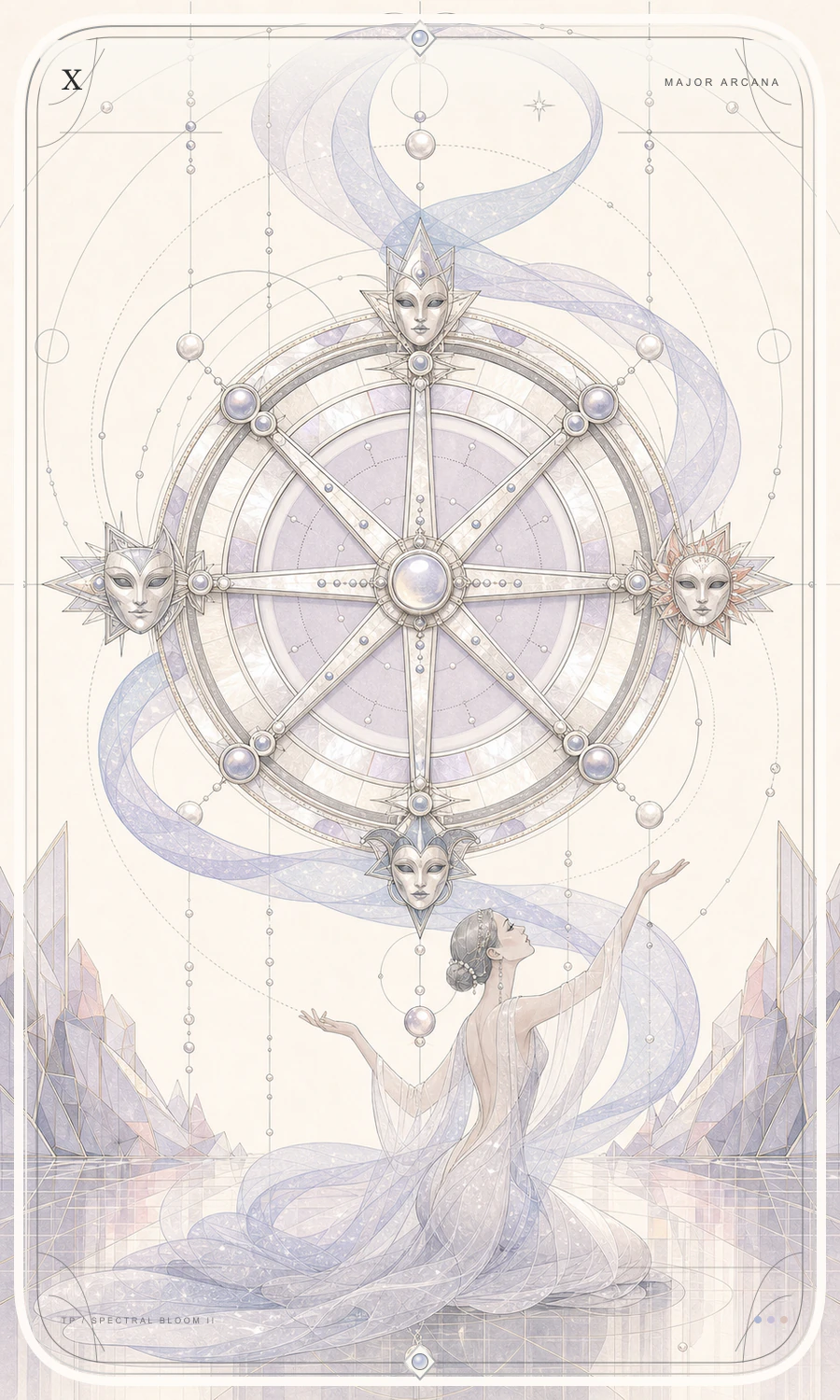
Three cards create a sentence
A one-card reading gives focus; a large spread gives detail. Three cards offer something different: movement. One card can establish a condition, the next can alter it, and the third can show consequence or response. Read them as a sentence rather than three separate entries in a dictionary.
Choose position names before shuffling. Positions are grammatical roles. Situation–action–outcome produces a different story from body–mind–spirit even when the same cards appear.
Use past–present–future carefully
Past–present–future is popular because it feels intuitive, but the future position should not be treated as a fixed verdict. Read it as the direction created by current conditions. This preserves the value of consequence without pretending that choices no longer matter.
Keep the past relevant to the question. The first card is not a biography; it describes the influence that still reaches the present. Ask what is being carried forward and whether it needs continuity or revision.
Try structures built for action
Situation–challenge–response is useful when you feel stuck. Option A–Option B–decision criterion is useful when two paths are competing. What to keep–what to release–what to invite is useful during transition. The best spread makes the required thinking visible.
Avoid positions that repeat each other. “What I feel,” “my emotions,” and “my heart” may create three versions of the same answer. Contrast produces information.
Read each card in position first
Give every card one sentence that includes its position: “The Two of Swords in the challenge position shows that postponing a choice has become the obstacle.” This keeps the interpretation attached to the spread.
Do not search for connections until each sentence is stable. Otherwise a visually striking card can dominate the others before you understand their individual roles.
Then look for direction and contrast
Notice where figures look, whether motion moves toward or away from the center, and whether colors or landscapes change across the line. A figure in card one looking toward card two can suggest engagement; two figures turned away may show a split in attention.
Compare suits, numbers, and scale. A Major between two Minors may name the deeper lesson inside a practical sequence. A progression from Swords to Cups to Pentacles may move from thought, through feeling, into material action.
Close with a conditional summary
Use language such as: “Given this situation, if this pattern continues, the likely direction is…” Then name what could alter that direction. Conditional language is both more accurate and more useful than announcing certainty.
Finish with one question the spread leaves open. A good reading does not eliminate mystery; it gives uncertainty a shape you can work with.